



How to Identify False Breakouts Like an Experienced Trader
Written by
| Reviewed by Abdul Latheef K
Last updated on
May 14, 2026
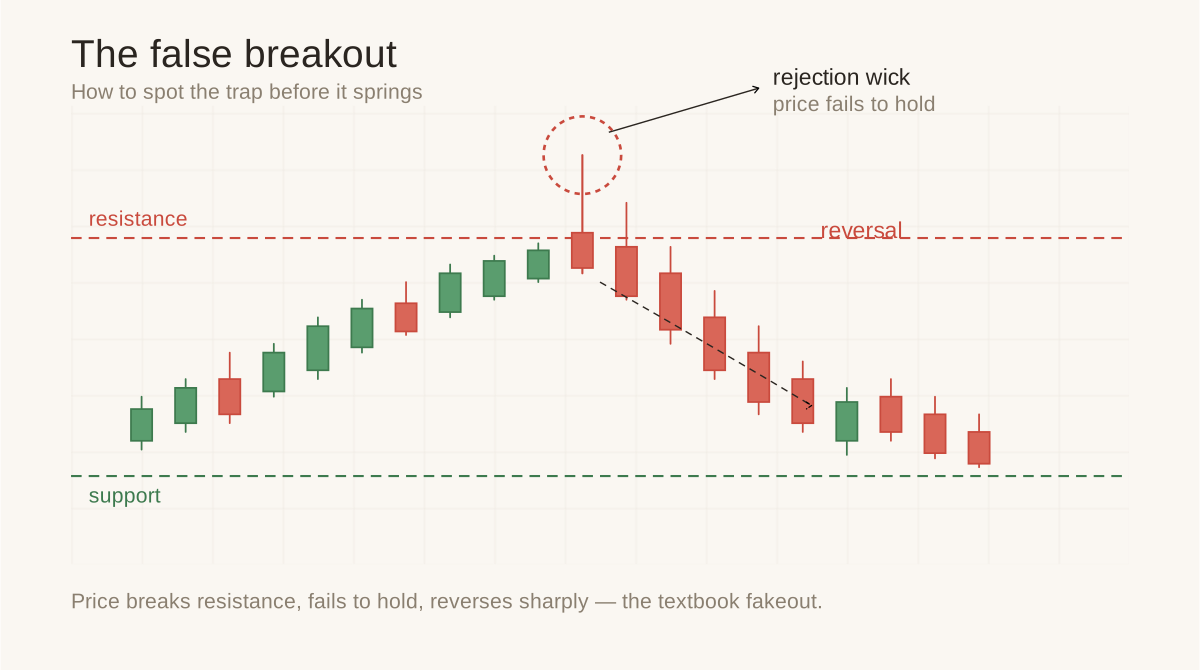
False breakouts happen more often than many traders expect.
According to one Trading Rush analysis, breakout trades were not consistently successful across all examples reviewed. The results showed that many breakouts failed shortly after the price moved beyond a key level, highlighting the importance of confirmation before entering a trade.
However, how to identify a false breakout pattern? A trader can notice it on the basis of candle closing prices, volume indicators, retracement, rejection off the wick, and general trend direction.
In this blog post, we will review what false breakouts are, what causes them, how to identify them, how to trade a false breakout, and more.
sec2
What Is a False Breakout
A false breakout occurs in a market when the price makes a move in a particular direction, either breaking above the resistance level or moving below the support level, but not continuing to do so.
In the case of a false breakout, the price rapidly reverses and moves in the opposite direction after breaching a resistance or support line.
A false breakout can occur in several ways and markets, including forex, stocks, cryptocurrency, commodities, and indices. This market event tends to occur mostly at important chart levels, such as support/resistance levels, trend lines, ranges, and chart patterns.
Learning how to identify a false breakout in forex is an essential trading skill that helps you avoid bad entries. Most forex traders have adopted indicators, volume, and candles as part of their forex trading strategy to check that they don’t fall victim to a false breakout.
sec2
Why False Breakouts Happen
False breakouts do not occur by chance.
In some cases, institutional traders may anticipate where retail traders are likely to place stop-loss orders around key support and resistance levels. This can contribute to short-term price movements beyond those levels before the market reverses.
After stop-loss orders are triggered, the additional liquidity may create conditions that allow larger market participants to enter or exit positions more efficiently.
In this section, let’s have a detailed discussion on some of the reasons why false breakouts happen.
1. Lack of Strong Buying or Selling Pressure
A true breakout may typically require substantial momentum and a lot of participation by investors in the market. Low trading volume during a breakout can make the move unsustainable.
In many such instances, the price might only go marginally past the level and then lack buyers or sellers to continue the trend.
For instance, a bullish breakout above resistance may attract buyers into the trade, but the follow-up action may often prove inadequate, leading to a reversal soon after.
This often happens when traders enter only because they see the level break on the chart, without checking whether there is enough strength behind the move.
Common signals of a weak breakout pressure include:
- Low trading volumes.
- Smaller breakout candlesticks.
- No follow-through candles.
- Slow movement after the breakout.
- Minimal participation by buyers or sellers.
2. Stop Hunt by Large Players
Another leading cause of a fake breakout is a stop hunt. Traders tend to set their stop-loss orders either just above the resistance level or just below the support level.
Large traders who recognise these stop-loss areas may push prices beyond those levels to trigger stop orders and pending orders.
After the stop orders get triggered, liquidity floods into the market. Large traders may then take advantage of this liquidity by placing orders against the prevailing trend. Following this, the market tends to move strongly against the trend.
This explains why fake breaks usually have longer rejection wicks. These indicate that the price moved above or below the level, and stop orders got triggered but failed to hold above or below the level.
3. News Volatility
High-impact news can also cause false breakouts. There are instances when the price moves rapidly in one direction in a few seconds during a big announcement. But this movement might not necessarily be sustainable.
The following events usually generate false breakouts:
- CPI numbers.
- NFP numbers.
- Interest rate changes.
- GDP numbers.
- Earnings reports of companies.
- Central bank speeches.
For example, suppose there were higher-than-expected inflation figures published. The currency pair will most likely break through its resistance level.
But then, the market may realise that this number was already priced in. Consequently, the price will quickly retrace and form a fake breakout.
So, learning how to identify the false breakouts in trading can help you understand these situations and avoid potential losses.
4. Low Liquidity Periods
The likelihood of a false breakout is higher during periods of low liquidity because there are fewer market participants. This means that a small number of orders can also result in price movements beyond key levels.
Liquidity is normally low in the late New York session, before the opening of London sessions, on holidays and during pre-market conditions in stocks. False breakouts can also occur in cryptocurrency markets, especially over the weekend.
Even though prices might seem like they broke support/resistance, the breakout may lack conviction, making them less reliable. Experienced traders normally shy away from breakout trading during times of low activity because of these reasons.
A breakout is likely to be more credible during times of active trading.
sec2
How to Identify False Breakout
Understanding how to identify false breakouts can help traders avoid poor entries and reduce unnecessary losses. Even though identifying a real and fake breakout can be tricky at times, there are ways to help recognise them.
In this section, we will have a detailed discussion of some of the ways that help recognise a false breakout, resulting in reduced unnecessary losses.
1. Watch the Candle Close
A common mistake traders make is taking positions immediately when the price breaches a support or resistance zone. A brief move beyond support or resistance does not always confirm a valid breakout.
Waiting for the candle to form a close may give traders a better understanding. The breakout may not be accurate if the candle closes within the zone again. This is particularly true in higher time frames since candles could undergo drastic changes before closing.
Another important signal traders should consider is the presence of long wicks. Rejection of higher prices becomes evident when the price moves above resistance, forms a long upper wick, and then closes back below the level.
Typical candlestick formations in a false breakout are:
- Long upper wicks past the resistance zone.
- Long lower wicks past the support zone.
- Tiny breakout candles.
- Bearish engulfing candles after a bullish breakout.
- Bullish engulfing candles after a bearish breakout.
2. Check the Trading Volume
Trading volume is the most helpful indicator that can be used to validate a breakout. Genuine breakouts tend to coincide with higher volumes, as many participants may be involved in the action.
The breakout may not be genuine if the volume is weak, as it might not be robust enough to continue.
When there is no significant volume increase after the price crosses a level, it may be an indication of a lack of conviction in the market. It may result in a fast reversal that can trap early traders who entered early.
For instance, when you start forex trading with EUR/USD, it may cross its resistance during a quiet session with very low volume.
Initially, traders may see it as an upward breakout that is bullish. However, if the buyers do not participate in the process, the price might retrace below its resistance point.
3. Look for Retests of the Breakout Level
Most breakouts may retest the broken level before resuming their course in the direction of the breakout. This can provide further confirmation on the legitimacy of the breakout move.
When prices break out of resistance, they may most likely return to that level and test it again as new support. The breakout is more likely to be genuine if the price continues at a higher level, even if the buyers defend the level.
However, a failed retest can be a warning sign. The breakout may be false if the price breaks above resistance and falls back below it after the retest. Conversely, the same rule applies to support.
Many experienced traders often wait for the retest before entering the trade because it helps them identify false breakouts more easily.
4. Pay Attention to Wick Rejections
Wick rejections are powerful indicators of market sentiment.
Long upper wicks above resistance often indicate that buyers pushed prices higher but were unable to maintain momentum. Long lower wicks beyond the support level usually indicate that bears were unable to force prices lower.
These wicks are important because they signal the failure of the price action. In many instances, the longer the wick, the stronger the rejection.
Some crucial wick formations include:
- Long upper wicks beyond the resistance level.
- Long lower wicks beyond the support level.
- Multiple rejection wicks at the same level.
- A combination of wicks and a poor candlestick close.
5. Use Multiple Timeframe Analysis
Many traders concentrate on using one chart timeframe when identifying possible trading opportunities.
Even when a breakout looks strong on the 5-minute chart, there is a chance that the breakout may not hold when the price reaches the critical resistance point seen on the daily chart.
This is why higher time frames are important. They give a bigger picture of the market and help traders avoid taking weak breakouts against stronger trends or resistance zones.
The usual technique is to use:
- Daily charts to see the general trend.
- Hourly charts to spot support/resistance points.
- 15-minute or 5-minute charts to enter the trade.
In general, higher time frame breakouts are safer than lower time frame breakouts, as more traders participate in higher time frames.
6.Check Market Context
A breakout tends to be more effective if it takes place according to the trend’s direction. The upside breakout may perform better in a bullish market, while a downside breakout tends to work best in a bearish market environment.
Breakouts that occur against the prevailing trend may have a lower probability of success because they often require stronger momentum and broader market support. This explains the importance to analyse broader market context along with the breakout itself.
Traders should consider the following questions in such situations:
- Which is the market’s condition, trending or ranging?
- Is it a breakout along or against the current trend?
- Are there any levels of support or resistance close by?
- Is there any upcoming significant news?
- What about the market’s activity level?
7. Use Technical Indicators for Confirmation
Indicators can be useful in identifying if the breakout is strong or weak. But indicators should only support price action, not replace it.
Some useful indicators include:
If RSI is already in overbought territory during a breakout, traders may want to look for additional confirmation because strong trends can remain overbought for some time.
Likewise, if there’s no confirmation from the MACD indicator and low volumes, then the breakout may likely fail.
Moving averages can tell whether the prevailing trend holds. Similarly, Bollinger Bands can tell whether prices are moving beyond their natural boundaries.
8. Observe How Fast Price Returns
A clear indication that a breakout is fake is when the price returns to the range quickly. When price breaks above resistance but returns below resistance, it often indicates that buyers were unable to hold the price.
The quicker the reversal, the more likely the breakout was weak. Traders who got into positions too soon before the breakout often find themselves trapped when prices reverse suddenly.
Pullbacks after breakouts are possible, but a quick return to the range can be a sign that the breakout failed.
sec2
How to Trade False Breakouts
While many traders think of how they can avoid false breakouts, many other traders employ such situations in their trades, as false breakouts can lead to strong reversals. While traders may enter the market wrongly and run out of the market too soon, there can be a quick market movement the other way.
Here, let’s see how one can trade such false breakout situations.
Wait for the Breakout to Fail
The first rule involves waiting for the breakout to fail. In other words, traders should not enter when the price moves past resistance or support. Rather, it’s better to wait for it to come back to the old range.
For example, consider a scenario where price breaks higher from resistance but closes back below it. This often means that sellers have taken control again, thus setting up a possible fake-out scenario.
An account, r/Daytrading on Reddit, was complaining about how they used to lose money consistently by buying every breakout candle.
However, after some time, they figured out that all the losses were because of the early entry and that if they waited for the failure of the breakout, their profits would improve.
Enter After Confirmation
Many traders wait for confirmation before entering a false breakout trade because it may reduce the risk of entering another weak setup.
Common confirmation signals are:
- A rejection candlestick with a long wick.
- Bearish engulfing candlestick after a bullish breakout.
- A bullish engulfing candlestick after a bearish breakout.
- Failure to test the support and resistance levels.
- Volume spike during the reversal.
According to Nial Fuller, a professional trader, most of his profitable forex trades have been through patience of waiting for a rejection candlestick before confirming the reversal.
Place Stop Loss Beyond the Wick
Stop placement is important in false breakout strategies because price action can be highly volatile. Most of the time, a trader puts a stop just after the wick of the rejection candlestick.
For instance:
- In the bearish false breakout pattern formed above the resistance, the stop loss level can be established right after the topmost wick.
- In the bullish false breakout pattern formed below support, the stop loss level is typically placed below the bottommost wick.
This way, there can be some space for trade movement while ensuring that risks are well-managed.
Target the Opposite Side of the Range
In some cases, after a false breakout occurs, the price may move back toward the opposite side of the range or toward the next significant support or resistance level.
It makes sense, considering that when there is a failure in the breakout attempt, the price level typically bounces back to the opposite side of the range.
For example, if price breaks above the top of a range and then fails, traders may target the lower boundary of that range. If price breaks below support and reverses upward, traders may target the previous resistance zone.
This type of trade pattern is common in range-bound markets, although false breakouts can also occur during trends.
Manage Risk Carefully
Fakeout trades tend to be very fast. That is the reason why risk management is essential. Despite the fact that the setup may look good, one should not trade all their money in one transaction.
There are some traders who tend to cut their position sizes when executing false breakouts due to extra volatility. On the other hand, some traders never risk more than a certain percentage of their total balance on one trade.
Goverdhan Gajjala, a day trader, mentioned that one of the things he did wrong during the early years of his career was risking too much capital on breakout trades without proper confirmation. He learnt the hard way that patience is better than greed.
sec2
Conclusion
False breakouts occur quite often in trading, yet they might not always have to lead to unnecessary losses. Traders who understand the causes of false breakouts may be better positioned to identify weak setups and make more informed decisions.
Monitoring candles’ closures, volumes, retests, wick rejections, timeframes, and market context can be used to verify a breakout or check whether it is a fakeout.
Learning how to identify false breakout setups can help traders avoid poor entries, reduce emotional trading, and improve overall decision-making. They would not be able to enter the position too early and could save money. Moreover, some traders use fake breakouts to trade on reversions.
Taking time to wait for confirmation may help traders reduce the risk of entering weak breakout setups.
Not every breakout deserves a trade. If traders spend more time studying market charts, they can more easily recognise when the breakout is fake.
Author Info
Uma Nair is a professional content writer with over 3 years of experience and a strong foundation in crafting engaging and informative content across diverse domains. Over the years, she has dealt with various niches, and her growing interest in finance has led her to explore the world of financial writing. As an English Language and Literature postgraduate, her educational background supports her ability to convey complex topics in easy and accessible content. In her free time, she stays updated on industry trends to continually enhance the value of her content.

Reviewed by
Abdul Latheef K is a Researcher at Jawaharlal Nehru University, New Delhi. He is also an Author, Educator, and Expert in personal finance and Investment. His areas of interest comprise the Stock Market, foreign capital flows, and Open Economy Macroeconomics.
Disclaimer:
The information provided on this blog is for general informational and educational purposes only and is not intended as financial, investment, legal, or tax advice. While we strive to ensure accuracy, completeness, and timeliness, the financial world is dynamic, and content may become outdated or subject to change. Always conduct your own research or consult with a qualified financial advisor before making any investment or financial decisions. The authors and publishers of this blog are not liable for any losses or damages arising from the use or reliance on the information presented.
sticky end
Recent Posts

Share this post
Pages
Plans
Legal
Zyvest Capital Prime Ltd (www.zyvest.com) is licensed and regulated by the Financial Services Commission (FSC) of Mauritius as an Investment Dealer (Full Service Dealer, Excluding Underwriting) under Licence No. GB25204874 | Code: SEC-2.1B, issued on 29 August 2025.
Risk Statement : An investment in derivatives may mean investors may lose an amount even greater than their original investment. Anyone wishing to invest in any of the products mentioned in www.zyvest.com should seek their own financial or professional advice. Trading of securities, forex, stock market, commodities, options and futures may not be suitable for everyone and involves the risk of losing part or all of your money. Trading in the financial markets has large potential rewards, but also large potential risk. You must be aware of the risks and be willing to accept them in order to invest in the markets. Don’t invest and trade with money which you can’t afford to lose. Forex Trading are not allowed in some countries, before investing your money, make sure whether your country is allowing this or not.
You are strongly advised to obtain independent financial, legal and tax advice before proceeding with any currency or spot metals trade. Nothing in this site should be read or construed as constituting advice on the part of Zyvest Capital Ltd. or any of its affiliates, directors, officers or employees.
Contracts for Difference (CFDs) are complex financial instruments and come with a high risk of losing money rapidly due to leverage. A significant percentage of retail investor accounts lose money when trading CFDs with providers. You should consider whether you understand how CFDs work and whether you can afford to take the high risk of losing your money.
CFDs are not suitable for all investors. Ensure you fully understand the risks involved and seek independent advice if necessary. Past performance is not a reliable indicator of future results. Please read our full Risk Disclosure Statement, Terms and Conditions, and Privacy Policy before engaging in any trading activity.
Disclaimer : Zyvest Capital Ltd. does not provide services for citizens/residents of the United States, Cuba, Iraq, Myanmar, North Korea, Sudan. The services of Zyvest Capital Ltd. are not intended for distribution to, or use by, any person in any country or jurisdiction where such distribution or use would be contrary to local law or regulation.