



Can I Start Forex Trading with $10? What Beginners Should Know
Written by
| Reviewed by Abdul Latheef K
Last updated on
July 9, 2026

According to the Bank for International Settlements, trading in over-the-counter foreign exchange markets reached about $9.6 trillion per day in April 2025.
Given the size of the forex market, can beginners start trading forex with just $10? Technically, yes. Some forex brokers, based on their jurisdiction and account offering, may provide cent, micro, or nano accounts that allow very small deposits.
A small live account may help some beginners experience real-order execution and emotional pressure, but they should only use the money they can afford to lose.
However, such an account cannot be considered for income generation. This blog explains whether you can start trading with $10, when a $10 account makes sense, the risks, beginner mistakes, and smarter ways to start.
sec2
Can You Start Forex Trading With $10?
Yes, it is possible to start forex trading with $10 if your broker allows small deposits and supports cent, micro, or nano-lot trading. This makes it technically possible to place real trades with a very small balance.
Nevertheless, trading forex with only $10 is primarily a way of gaining experience rather than making profits. With this amount of money, you may learn how spreads and slippage affect entries, exits, and trade costs. But it may not be enough to build meaningful income or trade with serious financial expectations.
In practical terms, a $10 forex account should be treated as a training ground for your practical knowledge, not an income generator. It may help you practise discipline, but it should not be used to chase daily profits or fast account growth.
sec2
What Starting with $10 Really Means
Beginning with $10 does not imply that you have begun to establish a business in forex trading. Instead, you have begun to trade with an amount to get familiar with what actual trading entails.
Unlike demo trading, a live account creates emotional pressure because real money is involved. Even a small loss may significantly affect your confidence and decision-making.
In forex trading with $10, you may learn the following:
- How to place buy and sell orders.
- How spreads affect entries and exits.
- How stop-loss and take-profit levels work.
- How lot size affects position exposure.
- How leverage can magnify gains and losses.
- How emotions affect trading decisions.
For instance, taking a 1% risk on $10 means risking only $0.10 for each transaction. That protects capital, but it also shows why the profit potential is very small.
When a $10 Forex Account Makes Sense
The main reason to open a $10 forex account is to gain practical experience, not to earn income. After becoming familiar with demo trading, such accounts may help you understand the difference between simulated trading and live trading.
With a $10 forex account, you may test the broker’s platform, know the live spread and slippage, practise placing orders, and learn about live stop-loss and take-profit.
If you are an absolute beginner, then opening a $10 forex account is a good opportunity for you to become aware of your ability to follow certain rules, take losses, avoid revenge trading, and control position size.
Again, the main aim here is not earning big money but developing the discipline required for trading.
Manshood, a full-time trader, shares that in his initial trading days, demo trading felt easy because there was no real money involved. But once he shifted to a small live account, even a small loss created emotional pressure.
According to him, this is where beginners start understanding the real side of trading. A $10 account may not create meaningful profit, but it can reveal fear, impatience, revenge trading tendencies, and discipline gaps in a real-market environment.
When a $10 Forex Account Does Not Make Sense
A $10 forex account does not make sense when the trader expects high income from it. The balance is too small to generate meaningful profit while following proper risk-management rules.
For example, a 10% gain on $10 is only $1. To turn $10 into $20, the account would need a 100% gain, which may encourage excessive risk-taking.
So, a $10 account may be a wrong choice if you aim for the following:
- Generate a regular income.
- Recover from losses.
- Double up on account quickly.
- Use aggressive trading strategies.
- Scalp without knowing spreads and execution costs.
Bad trading habits developed on a small account may continue even while dealing with larger accounts. Therefore, use the $10 account only for practice and learning.
Let’s have a quick overview of whether a $10 account is suitable based on your goals:
| Goal | Is $10 Suitable? | Why |
|---|---|---|
| Learn order placement | ✅ Yes | Low-cost practice. |
| Test live emotions | ✅ Yes | Real money creates psychological pressure and helps build trading discipline. |
| Build income | ❌ No | The profit potential is too small to generate meaningful income. |
| Scalping aggressively | ❌ No | Spread costs and leverage risk make this approach unsuitable for a $10 account. |
| Recover losses | ❌ No | Trying to recover losses with a very small account often encourages gambling behaviour. |
sec2
Why Forex Trading With $10 Is Usually Not Practical
Opening a forex account with just $10 might seem like an appealing choice due to the minimal required initial investment. However, the true challenge lies not in opening the account, but in managing the risk once the trading starts.
Because the account balance is so small, risk management poses serious restrictions on trading operations. Applying the 1–2% risk ratio will allow risking only $0.10-$0.20 per trade.
While it preserves the safety of the investment, it limits earnings significantly. If you increase the risk to make trading feel exciting, the account becomes easier to lose.
Below are some factors that make forex trading with $10 not practical.
The Risk Management Problem
Risk management is challenging in a $10 account. The 1% risk is just $0.10, and the 2% risk is $0.20 for such accounts. Although this is a safe approach, many beginners consider it too slow.
The danger is when the trader decides to take risks worth 5% or 10%. That means risking $0.50 to $1 from an account worth $10. It may be interesting, but such risks may lead to a quick deterioration of the account. Responsible risk may feel too slow, while aggressive risk can quickly damage the account.
The Profit Expectation Problem
Profit expectation is another crucial problem while trading on small accounts. A 5% profit from $10 will amount to $0.50, while a 10% profit amounts to $1. A trader who expects to make a profit of $10 from the $10 account requires a 100% profit.
For many beginners, this is not a realistic expectation. When the trader realises they are making no significant profit, they might end up using higher lot sizes, more leverage, and just random trades.
The Leverage Trap
Leverage may be tempting with small accounts because it allows traders to control a larger position with a smaller margin deposit. However, such a strategy accelerates losses considerably.
According to FINRA, forex transactions with high amounts of leverage may lead to substantial profits or losses from minimal currency fluctuations. Thus, high leverage can pose significant risks to inexperienced traders and may lead to rapid losses if positions are not managed carefully.
Therefore, the use of leverage should not be considered an easy way out. With forex trading with $10, the focus should be on learning lot size, stop-loss placement, risk management, and emotional control.
sec2
$10 Forex Trading Case Study: What Actually Happens
To understand the reality of forex trading with $10, let us look at some simple beginner case studies. These examples are not about showing how to make big profits. It is about showing what actually happens when a trader uses a very small live account with proper risk control.
Case Study Setup 1
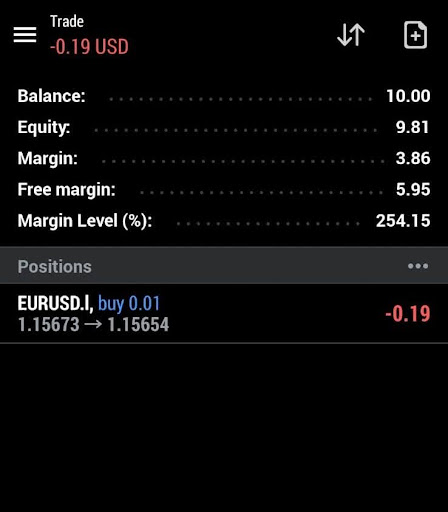
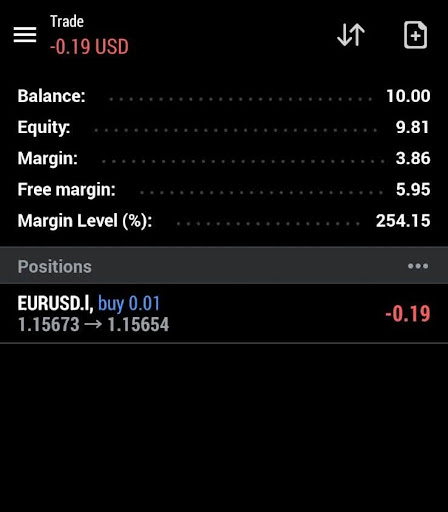
In this setup, the trader currently has an open long position of 0.01 lots of the EUR/USD Currency pair. While the account balance remains unchanged at $10, the equity of the account is at $9.81, as there is an open trade with a floating loss of $0.19.
Though this amount appears relatively small, for an account balance of $10, $0.19 translates into almost 2% of the total balance. This shows how even a small market movement can create emotional pressure in a tiny live account.
Case Study Setup 2
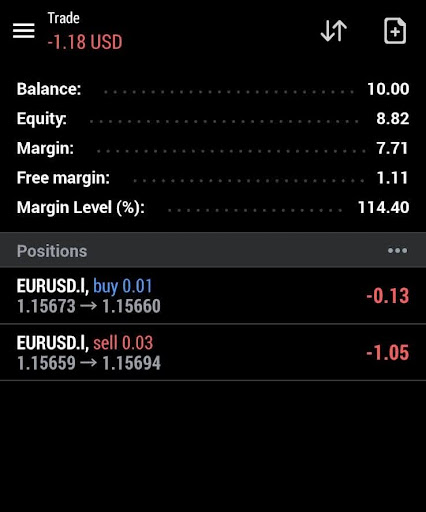
In this screenshot, we can see there are two open trades on the EUR/USD pair, one long trade of 0.01 lots and another short trade of 0.03 lots. The current balance is $10. However, the equity falls to $8.82 due to the floating loss of $1.18 on both open positions. As you can see, the negative P/L for both open trades totals 11.8%.
Case Study Setup 3
sec2
sec2
In this setup, there is a EUR/USD buy trade that has been closed and incurred a loss of $0.83. The account balance has reduced from $10 to $9.17. Although $0.83 might seem like a small loss, it is 8.3% of $10 and significantly above the average 1-2% risk rate.
In summary, these screenshots prove that it is possible to trade using 10 dollars, although it is quite limited. The trader can make transactions, test executions, and also experience real emotions. However, a large percentage can be lost in the account within a short period of time if lot size, leverage, or risk is not controlled.
sec2
Beginner Mistakes That Destroy a $10 Forex Account
As we have already discussed, a $10 account is best suited for learning purposes. However, many beginners fail while using such small accounts, as they often ignore them and use these accounts to make a profit.
If you plan to start trading with $10, consider avoiding the following mistakes:
Using Too Much Leverage
High leverage allows traders to trade larger positions with small balances. Although this may look attractive, especially when your capital is small like $10, it may also cause losses faster.
When forex trading with $10, leverage can be dangerous if used for the following:
- Open bigger positions than your account can handle.
- Recover a previous loss quickly.
- Make small profits feel larger.
- Trade without calculating risk first.
Trying to Flip $10 Fast
Many beginners have a common question: ‘Can I start forex trading with 10 dollars?’ In many cases, they seek the possibility of developing a small account rapidly. The trouble begins if they attempt to turn $10 into $50 or even $100 in a short time.
This may often lead to gambling-style behaviour, as the trader may increase lot size, enter random trades, or take revenge trades after a loss. In such cases, these accounts become a place for emotional decisions rather than learning.
Trading Without a Stop-Loss
A stop-loss is critical for any trading account. It becomes way more important with small-amount accounts, as without a stop-loss, even one bad trade may cause significant loss.
Beginners may also move their stop-loss when the trade goes against them. This is dangerous because it turns a planned trade into an emotional trade.
Scalping With High Spread
Scalping can be difficult with a tiny account because spreads, execution speed, and trading costs matter more. If the spread is high, the trade may start at a disadvantage before the market even moves in your favour.
Moreover, for complete beginners, scalping with a $10 account can create pressure to enter and exit too quickly. So, it is good to focus on clean setups, low-spread pairs, and proper risk control rather than trying to take many small trades.
Measuring Success Only by Profit
In forex trading with $10, profit should not be the only measurement of success. Here, the capital is too small to earn a meaningful income. So, the real goal should be behavioural improvement and learning.
So, before judging your result, ask the following questions:
- Have I followed my plan?
- Was there a stop-loss in my trades?
- Did I risk only a small amount?
- Have I avoided revenge trading?
- Did I write down the reason for the trade?
If your answers are mostly positive, the $10 account is serving its intended purpose, helping you practise discipline, risk control, and process-based trading.
sec2
Better Than Starting With $10: A Smarter Beginner Path
The mistake is not starting small. The problem is starting small without a clear plan. What a new trader really needs is education, demo practice, risk management, trading strategy, and emotional management.
Instead of using the $10 as a means for fast profit, use it as just one of many steps that a new trader should take. Here is a smarter beginner path that you may consider:
Step 1: Start With Demo Trading First
Demo trading should precede actual trading. It allows a trader to familiarise themselves with the core mechanics of the forex market without putting their money at risk.
Demo trading may help you practise and improve the following:
- Platform basics
- Order types
- Stop-loss and take-profit placement
- Lot size calculation
- Simple strategy rules
When you become adept at executing a simple trade strategy in demo mode without making random moves, you can gradually shift to a small live trading account. This allows you to transition from practice mode to the live market with greater self-control.
Step 2: Use $10 Only for Live Emotion Training
After demo trading, starting a $10 trading account allows you to notice how emotions differ while trading real money. Though it sounds insignificant, the pressure may be quite different compared to demo trading.
At this stage, do not aim for income. Do not overtrade. Practise entries and exits, setting stop-loss, and utilising trading journals. Try to realise whether you may be able to follow the strategy under conditions when actual money is in danger.
Step 3: Move to a More Structured Beginner Account
Having grasped the basics, a switch to a structured beginner account becomes necessary. A structured beginner approach should involve more than simply depositing money and placing trades. A good structure includes:
- Basic education
- Risk principles
- Appropriate starting capital
- Trading plan
- Emotional-control skills
- Trade analysis
It allows you to avoid random trading and social signals on the Internet. The purpose is not simply to deposit funds but to approach trading with clearer rules and better risk control.
Step 4: Build a Better Beginner Foundation With Zyvest Capital
Instead of risking $10 randomly, beginners may consider a more structured route. These may include options such as ZyLite by Zyvest Capital.
However, before choosing any trading plan, they should assess the costs, risks, broker terms, leverage conditions, and whether the product suits their financial situation.
Designed for beginners, this trading plan of Zyvest Capital allows traders to invest up to $999. With a simple entry point suitable for beginners, ZyLite may also help one learn while trading and offers comprehensive market access.
Moreover, it also offers a structured trading environment for beginners, helping them familiarise themselves with the market and improve their discipline and confidence.
The focus should not be guaranteed profit. The aim needs to be improving discipline, risk management, and guidance. Compared with unplanned trading, any structured approach that includes education, risk limits, journaling, and clear rules may help beginners develop better discipline.
sec2
$10 Forex Trading vs ZyLite
Both a $10 account and ZyLite can be utilised by a beginner trader, but they may not be the same. $10 trading is just an experience of trading in the real market with a negligible amount of money to test your skills.
On the other hand, ZyLite could be considered a good beginner starting point because it involves more structure and guidance for beginners. It may be more suitable for beginners who want direction, preparation, and a clearer risk-management approach.
| Criteria | $10 Forex Trading | ZyLite |
|---|---|---|
| Main purpose | Live-market experiment | Structured beginner starting point |
| Best for | Testing emotions and execution | Beginners who want direction |
| Capital level | Very limited | Up to $999 for eligible beginners |
| Learning structure | Mostly self-guided | More structured positioning |
| Profit potential | Very limited | Depends on skill, risk, and discipline |
| Risk control | Often weak for beginners | Can support planned risk management |
| Emotional support | Usually none | Better preparation for beginners |
| Main warning | Easy to over-risk | Still requires discipline |
ZyLite does not represent an easy way out or a promise of profits. ZyLite should be considered a structured beginner path, not a shortcut or profit guarantee.
sec4
Final Verdict: Should You Start Forex Trading With $10
Yes, you can enter forex trading using $10 if your aim is learning execution, mastering emotions, and basic self-discipline. This may assist you in transitioning from demo trading to real market experience by using minimal funds.
However, $10 does not provide sufficient money when you aim to make a profit. The account is too small to create meaningful returns without taking high risk.
So, if the question is whether you can start forex trading using $10, then the honest answer would be yes, but only for learning. While a $10 forex account is not worthless, one must remember how to use it properly.
Author Info
Uma Nair is a professional content writer with over 3 years of experience and a strong foundation in crafting engaging and informative content across diverse domains. Over the years, she has dealt with various niches, and her growing interest in finance has led her to explore the world of financial writing. As an English Language and Literature postgraduate, her educational background supports her ability to convey complex topics in easy and accessible content. In her free time, she stays updated on industry trends to continually enhance the value of her content.

Reviewed by
Abdul Latheef K is a Researcher at Jawaharlal Nehru University, New Delhi. He is also an Author, Educator, and Expert in personal finance and Investment. His areas of interest comprise the Stock Market, foreign capital flows, and Open Economy Macroeconomics.
Disclaimer:
The information provided on this blog is for general informational and educational purposes only and is not intended as financial, investment, legal, or tax advice. While we strive to ensure accuracy, completeness, and timeliness, the financial world is dynamic, and content may become outdated or subject to change. Always conduct your own research or consult with a qualified financial advisor before making any investment or financial decisions. The authors and publishers of this blog are not liable for any losses or damages arising from the use or reliance on the information presented.
sticky end
Recent Posts


Share this post
Pages
Plans
Legal
Zyvest Capital Prime Ltd (www.zyvest.com) is licensed and regulated by the Financial Services Commission (FSC) of Mauritius as an Investment Dealer (Full Service Dealer, Excluding Underwriting) under Licence No. GB25204874 | Code: SEC-2.1B, issued on 29 August 2025.
Risk Statement : An investment in derivatives may mean investors may lose an amount even greater than their original investment. Anyone wishing to invest in any of the products mentioned in www.zyvest.com should seek their own financial or professional advice. Trading of securities, forex, stock market, commodities, options and futures may not be suitable for everyone and involves the risk of losing part or all of your money. Trading in the financial markets has large potential rewards, but also large potential risk. You must be aware of the risks and be willing to accept them in order to invest in the markets. Don’t invest and trade with money which you can’t afford to lose. Forex Trading are not allowed in some countries, before investing your money, make sure whether your country is allowing this or not.
You are strongly advised to obtain independent financial, legal and tax advice before proceeding with any currency or spot metals trade. Nothing in this site should be read or construed as constituting advice on the part of Zyvest Capital Ltd. or any of its affiliates, directors, officers or employees.
Contracts for Difference (CFDs) are complex financial instruments and come with a high risk of losing money rapidly due to leverage. A significant percentage of retail investor accounts lose money when trading CFDs with providers. You should consider whether you understand how CFDs work and whether you can afford to take the high risk of losing your money.
CFDs are not suitable for all investors. Ensure you fully understand the risks involved and seek independent advice if necessary. Past performance is not a reliable indicator of future results. Please read our full Risk Disclosure Statement, Terms and Conditions, and Privacy Policy before engaging in any trading activity.
Disclaimer : Zyvest Capital Ltd. does not provide services for citizens/residents of the United States, Cuba, Iraq, Myanmar, North Korea, Sudan. The services of Zyvest Capital Ltd. are not intended for distribution to, or use by, any person in any country or jurisdiction where such distribution or use would be contrary to local law or regulation.